Understanding What Makes a Fragrance Special
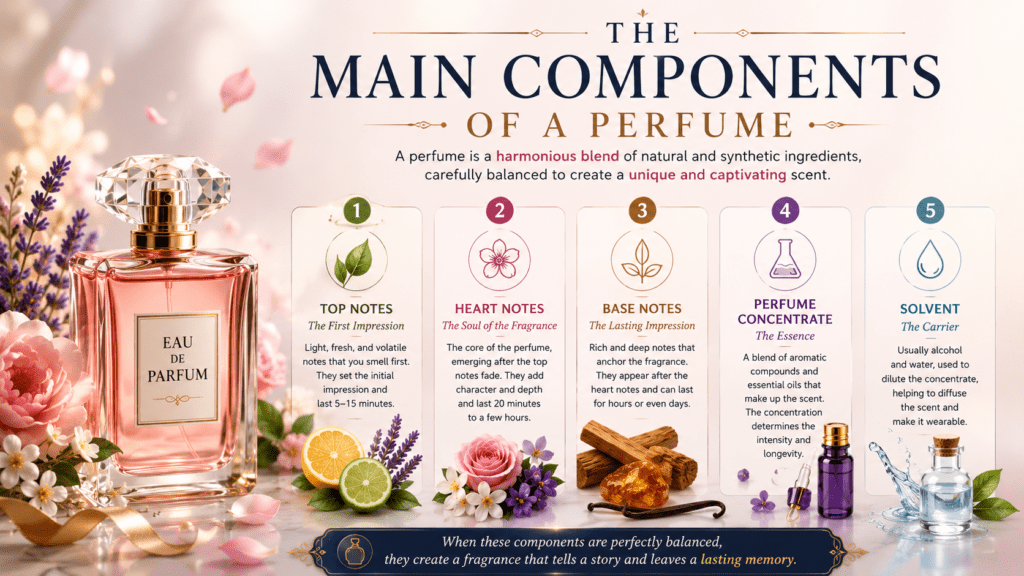
Perfume is more than just a pleasant scent—it’s a carefully crafted blend of ingredients designed to create a memorable sensory experience. From luxurious designer fragrances to niche artisanal creations, every perfume is built upon a combination of essential components that work together to produce its unique aroma and longevity.
Understanding the main components of a perfume can help you choose fragrances that suit your personality, lifestyle, and preferences. In this guide, we’ll explore the key ingredients and structure that make up a perfume and explain how each element contributes to the final fragrance.
What Is a Perfume Made Of?
At its core, a perfume consists of three primary components:
- Fragrance Oils
- Alcohol
- Water
In addition to these basics, many perfumes contain fixatives, preservatives, and specialty ingredients that enhance performance and stability.
Let’s take a closer look at each component.
1. Fragrance Oils: The Heart of Every Perfume
Fragrance oils are the most important part of any perfume. These oils provide the scent that you smell when applying a fragrance.
Fragrance oils can be derived from:
Natural Sources
Natural perfume ingredients come from plants, flowers, fruits, woods, spices, and resins. Common examples include:
- Rose
- Jasmine
- Lavender
- Sandalwood
- Oud
- Vanilla
- Bergamot
- Patchouli
These ingredients are extracted through methods such as steam distillation, solvent extraction, or cold pressing.
Synthetic Ingredients
Modern perfumery relies heavily on synthetic aroma molecules. These laboratory-created ingredients help perfumers achieve scents that may be difficult, expensive, or impossible to obtain naturally.
Benefits of synthetic ingredients include:
- Greater consistency
- Improved sustainability
- Enhanced longevity
- Lower production costs
- Unique scent possibilities
Many of today’s most popular perfumes combine natural and synthetic ingredients to create balanced and sophisticated fragrances.
2. Alcohol: The Carrier of Fragrance
Alcohol acts as the carrier that helps distribute fragrance oils evenly and allows the perfume to evaporate properly when applied to the skin.
Most perfumes use high-quality ethanol because it is:
- Colorless
- Nearly odorless
- Fast evaporating
- Skin-friendly
When perfume is sprayed, the alcohol evaporates quickly, releasing the fragrance molecules into the air. This process allows you to experience the scent’s development over time.
The amount of alcohol used varies depending on the perfume concentration:
- Parfum: 20–40% fragrance oils
- Eau de Parfum (EDP): 15–20% fragrance oils
- Eau de Toilette (EDT): 5–15% fragrance oils
- Eau de Cologne (EDC): 2–5% fragrance oils
Generally, higher oil concentrations result in stronger and longer-lasting fragrances.
3. Water: Balancing the Formula
Water is often added to perfume formulations to dilute the alcohol and create the desired concentration.
Although water doesn’t contribute directly to the fragrance, it helps:
- Stabilize the formula
- Adjust scent strength
- Improve skin comfort
- Ensure consistent performance
The amount of water used depends on the perfume type and intended concentration.
Understanding Perfume Notes
Beyond the basic ingredients, perfumes are structured using different fragrance notes that unfold over time.
A perfume is typically divided into three layers:
Top Notes
Top notes are the first scents you notice immediately after applying a perfume.
Characteristics of top notes:
- Light and fresh
- Quick evaporation
- Create the first impression
Common top notes include:
- Lemon
- Orange
- Grapefruit
- Bergamot
- Mint
- Green apple
These notes usually last between 15 minutes and 1 hour.
Middle Notes (Heart Notes)
Middle notes emerge once the top notes fade.
They form the core identity of the fragrance and often account for the largest portion of the perfume composition.
Popular heart notes include:
- Rose
- Jasmine
- Geranium
- Lavender
- Cinnamon
- Cardamom
Heart notes typically last several hours and create the fragrance’s main character.
Base Notes
Base notes appear after the middle notes begin to settle.
They provide depth, richness, and longevity to the perfume.
Common base notes include:
- Oud
- Sandalwood
- Cedarwood
- Amber
- Musk
- Vanilla
- Tonka Bean
These notes can remain on the skin for many hours or even an entire day.
Fixatives: Making Perfume Last Longer
Fixatives play a crucial role in perfume performance.
Their primary purpose is to:
- Slow the evaporation of fragrance oils
- Improve longevity
- Stabilize scent compositions
Traditional fixatives included natural ingredients such as:
- Ambergris
- Benzoin
- Labdanum
- Musk
Today, many modern perfumes use safe and sustainable synthetic fixatives that provide similar effects.
Without fixatives, fragrances would evaporate much more quickly and lose their complexity.
Preservatives and Stabilizers
Perfume manufacturers often add preservatives and stabilizers to ensure product quality over time.
These ingredients help:
- Prevent oxidation
- Maintain scent integrity
- Extend shelf life
- Protect against contamination
Proper stabilization ensures that a perfume smells the same months or even years after production.
Natural vs Synthetic Components
One common question among fragrance enthusiasts is whether natural ingredients are better than synthetic ones.
The truth is that both have advantages.
Natural Ingredients
Pros:
- Authentic scent profiles
- Luxury appeal
- Rich complexity
Cons:
- Higher cost
- Limited availability
- Variable quality
Synthetic Ingredients
Pros:
- Consistency
- Sustainability
- Innovation
- Better stability
Cons:
- Some consumers prefer all-natural products
Most premium perfumes use a combination of both to achieve the best results.
Why Understanding Perfume Components Matters
Knowing the main components of a perfume helps consumers make informed purchasing decisions.
By understanding fragrance oils, alcohol content, note structures, and fixatives, you can:
- Choose fragrances that match your preferences
- Understand perfume longevity
- Compare different concentrations
- Appreciate the artistry behind perfumery
- Build a fragrance collection more effectively
Whether you enjoy fresh citrus scents, elegant florals, rich oud fragrances, or warm gourmand blends, every perfume follows the same fundamental principles of composition.
Conclusion
Perfume is a fascinating blend of science, artistry, and craftsmanship. The main components of a perfume—fragrance oils, alcohol, water, and fixatives—work together to create the scents we love. Combined with carefully structured top, middle, and base notes, these ingredients transform simple raw materials into memorable fragrances that express personality and emotion.
The next time you spray your favorite perfume, you’ll have a deeper appreciation for the intricate blend of ingredients and expertise that make every fragrance unique. Understanding these components not only enhances your fragrance knowledge but also helps you select perfumes that truly suit your style and preferences.
Leave a Lasting Impression Wherever You Go – RocheHayatt Perfumes